I shall never forget my first impression of St Michael’s College, Tenbury. There was the climb up from the little
market town of Tenbury whence some of the lay clerks make their twice daily journey to Mattins and Evensong to lend
men’s voices to the boys’ choir, and there before me stretched an enormous common. In the far corner, in a lind of
blossoming orchards and backed by the blue distance of Clee Hill, rose a chapel, seemingly as large as Lancing.
Attached to it were Warden’s house, school buildings, cloister and dining hall, all in a style of the fourteenth century,
re-interpreted in local materials for the nineteenth century by the genius of its architect, Henry Woodyer. After
Evensong, where the music was equal to that of the best cathedral choirs, and a walk round the buildings in the quiet of
a Worcestershire evening, I visited the large dormitory, which runs almost the whole length of a building parallel with
the chapel. Here Christopher Hassall read his poem for Michaelmas Day (written for the centenary of St Michael’s
College, Tenbury) to the boys and held them spellbound as the stars shone through the narrow Gothic windows in the
gable roof.
St Michael’s College is a Tractarian dream come true. Its foundation stone was laid in 1854, and it was built and
endowed by Sir Frederick Ouseley, a rich bachelor baronet, who came under Tractarian influence when an under-
graduate at Christ Church. His musical talents were great and he sought to employ them for the Church of England
which he loved and in which he became a priest. He was Precentor of Hereford Cathedral and Professor of Music at
Oxford, where he raised that formerly disregarded faculty to one of eminence. At Tenbury he collected a library of music
and musical manuscripts which is world famous. But chiefly Sir Frederick was concerned to train boys who as organists
and choristers would be able to maintain the tradition of English cathedral church music. He, who had known
Mendelssohn and Elvey, and employed Stainer as organist at St Michael’s, and influenced Parratt, established a musical
tradition which has lived on and which has had a greater indirect influence on the Church of England’s music than any
other single institution. This is because it is not attached to one particular cathedral but serves the whole church.
Ouseley intended St Michael’s to be what it is— the parish church of the district, with a resident choir and organist
supplied from the College attached to it. By Victorian standards the College was well endowed with choir scholarships.
But inevitably, in order to maintain the choir, there has had to be an increasing number of non-choristers in the present
century, so that it is now both a preparatory school and a choir school. The unique quality of St Michael’s persists.
The air is still charged with music. It would be impossible for any boy not to be infuenced by the morning and
evening thanks to his Creator which he hears so perfectly sung in this tall chapel among the orchards of Worcestershire.
JOHN BETJEMAN
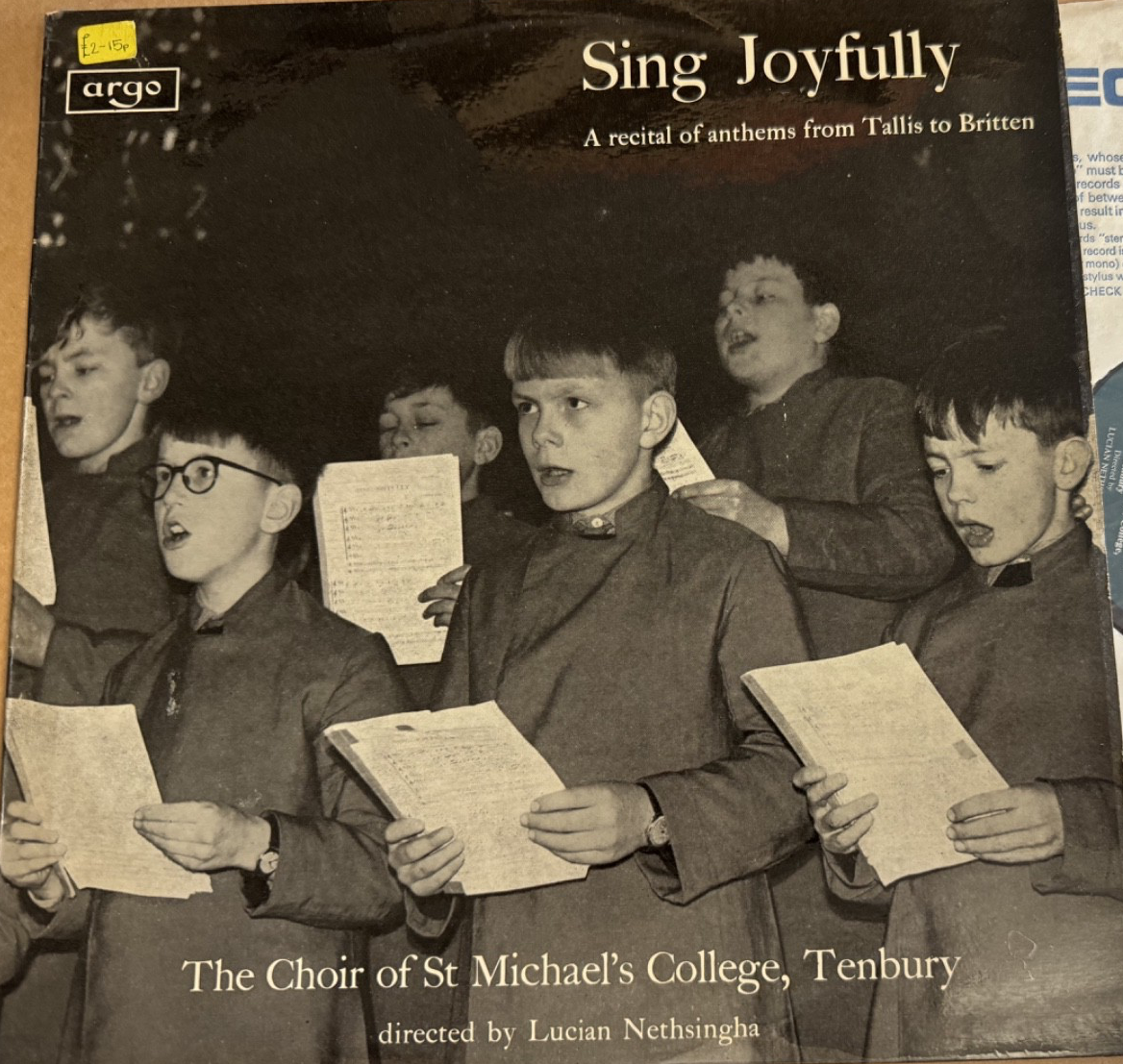
(Taken from the sleeve notes of the LP “Sing Joyfully”)
© John Betjeman 1965